
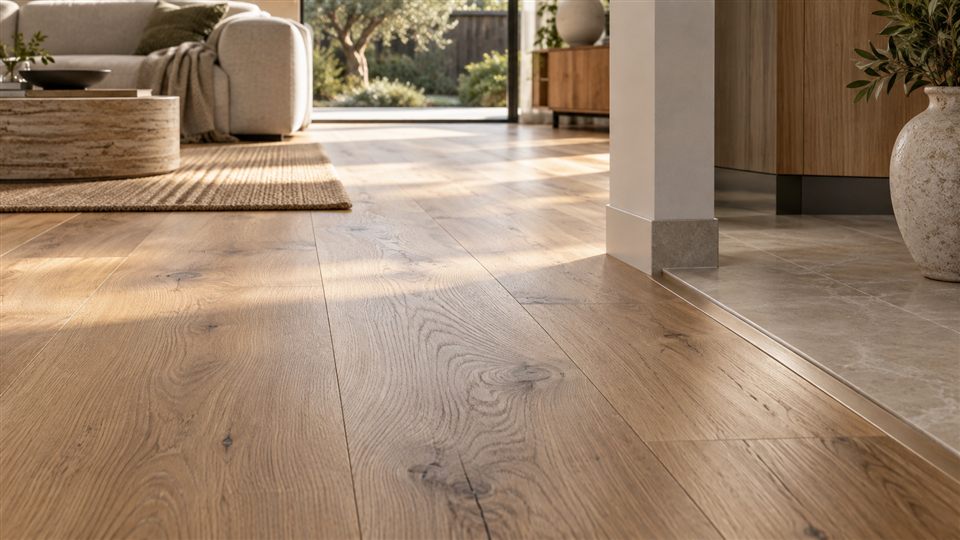
Condition Checks Before Timber Floor Restoration
Solid timber boards have timber through their thickness, but that does not promise an unlimited number of sandings or a fixed lifespan. Existing sanding, fixing position, damage, movement and the board profile affect what can be restored. Assess the actual floor before treating sanding and oiling as the solution; local repairs or a different finish approach may be needed.
Before selecting solid or engineered timber, understand slab or subfloor condition, flatness, moisture history, access, acoustic expectations and transitions to adjacent rooms. These factors affect preparation, installation method and long-term movement more than a showroom sample can reveal.
Solid and Engineered Timber Floors for the Room
Engineered flooring combines a timber surface with a layered construction. Products differ in wear-layer thickness, installation method, finish and repair options. Price and suitability cannot be expressed as one percentage of solid flooring. Check the manufacturer’s information and the existing floor before assuming it can be sanded or installed directly over a particular slab.
A ground-floor slab does not automatically make engineered timber suitable, and an upper floor does not automatically favour solid timber. Moisture assessment, subfloor preparation, acoustic requirements, floor height and the selected system need to agree. For rooms with frequent water exposure, confirm the product’s stated application limits before choosing any floor covering.
A sunny living room, upper-level bedroom, entry, apartment and renovation over an existing slab place different demands on timber flooring. Consider traffic, pets, direct light, furniture, cleaning habits and the desired feel underfoot. The most suitable product is the one whose visual character, maintenance needs and installation conditions all match the room’s real use.
Appearance, Movement and Floor-edge Details
Timber is a natural material and can show grain, tone and seasonal movement. Board direction, width, feature grade, finish sheen and transition details influence how that variation reads across a room. Discussing samples and laying patterns early helps clients choose a look they will value over time rather than expecting every board to be identical.
Flooring projects often become complicated at thresholds, fireplace surrounds, built-ins, stair nosings, skirtings and door clearances. These details deserve attention before the main field is installed. A clear plan for edges and transitions creates a more durable, finished result and prevents a small unresolved junction from holding up a larger room at the end.
Flooring Handover and Ongoing Care
The right cleaning method, furniture protection, prompt attention to spills and sensible use of mats can help preserve a timber floor. Care advice should match the selected product and finish, not rely on a generic rule. Ask what to avoid, how to treat minor wear and when a professional review is appropriate so maintenance becomes planned rather than reactive.
Solid and engineered flooring questions
Can an engineered timber floor be sanded?
Sometimes, but the remaining wear layer, previous sanding, damage and manufacturer’s requirements decide what is possible. Do not assume a standard number of refinishes applies to every engineered floor.
Is solid timber always more expensive?
No useful comparison follows from the material name alone. Compare the selected product, subfloor preparation, removal, installation, edges and finishing for the same room and scope.
Will oiling fix a damaged timber floor?
Oiling changes the surface finish; it does not resolve loose boards, moisture problems or deep damage. Assess the cause and condition before agreeing repairs and a compatible finish.
What belongs in a floor restoration quote?
Record the floor type if known, rooms, accessible condition, repair areas, preparation, finish, transitions, furniture handling and access. Separate concealed conditions and other trade work from the agreed floor scope.